Author Archives: wolfganghauck

PASCH Summer Course 2016 in Amman

A field report by Julia Mann, speaker
A project of the program “K-I-D-Z DaF-Doku-Theater” on behalf of the Goethe-Institut Amman
25. July 2016, Amman

Amman: For a week, I helped organize a workshop at a PASCH school in Amman under the direction of Wolfgang Hauck, one of the heads of the “K-I-D-Z DaF-Doku” program. There, the Goethe-Institut Amman organized a three-week summer course for young people and invited us. As an additional program, the regular lessons were to be supplemented with creative and activity-oriented offers for German lessons.

Of the 66 participants in total, a mixed group of 20 students who already had an advanced basic knowledge of German took part. Accordingly, the language level of the participants varied and ranged from A1.2 to A2. We therefore came up with creative techniques to integrate different language levels.

As a teacher of German as a foreign language, I have mainly worked with adults in Germany so far. This project was a new and exciting challenge for me. I had already worked with the workshop leader, Wolfgang Hauck, as an actress in the theater. This meant that I was able to provide qualified support to the students in the design of the workshop in the scenic work on the comic scenes, which I will go into later.

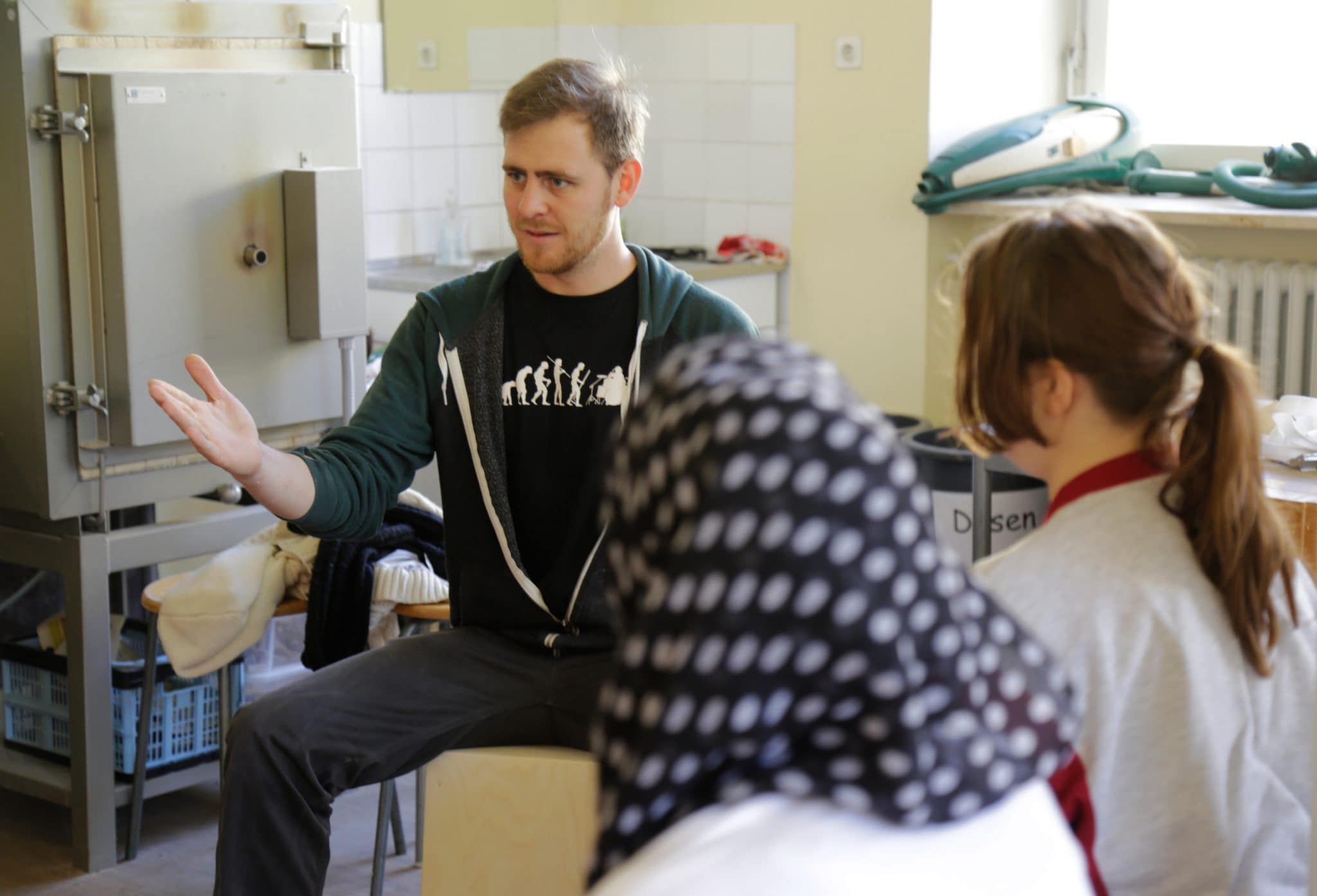
Each workshop day began with a warm-up with different objectives: Team building, language and expression training and coordination training. The respective linguistic topics of the previous day were playfully integrated into this. For example: the participants’ introductions were refined with movements and the new vocabulary was combined with voice training.

Thanks to our various methods from the fields of theater and art, we were able to design these warm-ups flexibly so that we could orient ourselves to the respective daily form of the target groups. The exercises we used were designed to loosen up and warm up the participants. Warming up – this is of course less necessary at 35 degrees, but still helpful in an air-conditioned room. We used classic running and movement games or concentration exercises for this. On the other hand, we also wanted to introduce new vocabulary for the participants to work with later. For example, we used counting games to consolidate the use of numbers or to playfully develop new vocabulary such as colors, nouns, etc.. New vocabulary was consolidated the next day through short repetition exercises. At the same time, we practiced the practical application of what we had learned during the warm-up by having the participants speak aloud in front of the group.

I considered this action-oriented approach to be extremely successful, as although the students had already made their first contact with the German language in class, their pronunciation and intonation skills were barely there due to the lack of practice. One of the aims was for each participant to be able to speak a few short sentences in confident and correct German loudly and clearly in front of the group at the end of the workshop.
Foto-Wolfgang-Hauck-20160719-Workshop-5w

To train attention and listening comprehension, we introduced the interview as a conversation format. First, the students interviewed each other and made audio and video recordings. We gave them a few questions to introduce and train fixed structures. We made sure that the correct question structures with regard to verb tense, indirect question sentences, etc. were adhered to despite the students conducting the interviews independently. In the course of these interviews, the students’ answers led to various interest groups with which we were then able to plan the further projects. The aim of this was to take the pupils and their ideas and wishes into account as far as possible and to ensure action-oriented learning.

COMIC
One of the groups, mainly older students at A2 level, mentioned in these interviews that they would like to work as a doctor one day. We then took up this career aspiration as a core topic and drew up an interview guide for an interview with a Jordanian doctor. The prerequisite was that the doctor also spoke German. Thanks to the contacts of the Goethe-Institut, we were able to organize an interview with Dr. Rami Kilani, a specialist in gynaecology.

The list of questions was then worked out in detail in German. This list of questions was then practiced intensively in role plays and the use of audio and video techniques was also practiced.

INTERVIEW
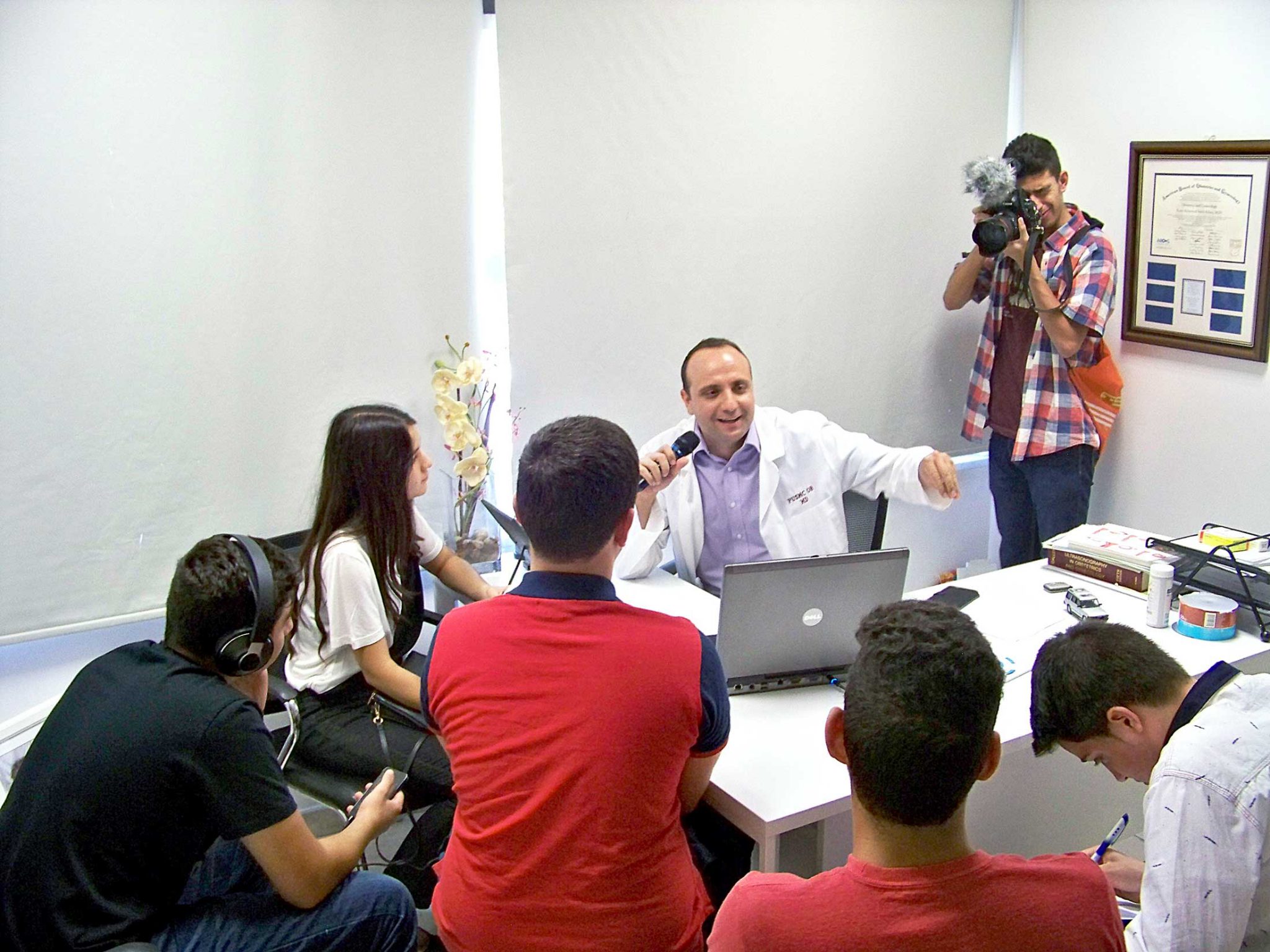
Foto-Wolfgang-Hauck-20160720-Interview-Rami-Kilani-4w

During the interview itself, the young people then took on the technical tasks in addition to the interview and recorded the doctor’s answers with photos, video and sound. This was later used to create a transcription, which the participants were also asked to write in German. This activity also allowed us to focus on listening comprehension and at the same time train written skills such as spelling, grammar and punctuation. The video material was later used to produce a movie as a making-of.

The young people were instructed in video editing by Wolfgang Hauck and were thus able to take over the rough cut and editing of the film independently. I was amazed at how interested the students were in the topic and how they were able to solve linguistically difficult situations on their own. The previously introduced vocabulary, which the participants were able to pick up relatively easily with the warm-up activities, was particularly helpful here. The students could and should also use the Internet as a research tool to obtain background information and thus had to practise using a wide variety of sources.
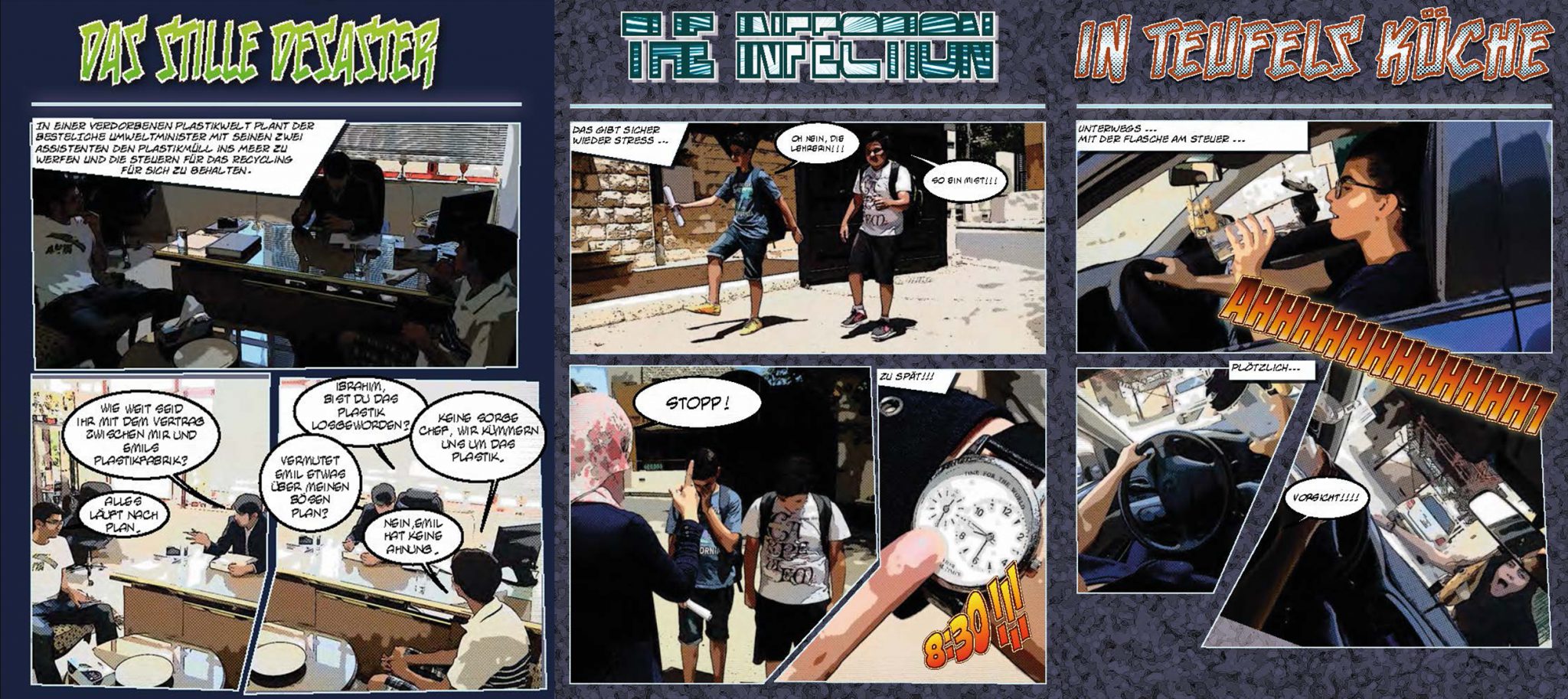
2016-Amman comic covers

For the other participants, we chose an activity that would use less vocabulary to suit the lower language level, but would incorporate more interactive and social components in a playful way. We chose the “comic” format for this. Since, on the one hand, drawing skills could not be assumed and, on the other hand, the playful and dramaturgical part should be in the foreground, we chose comics with photography.

The pictures are converted into comic style and designed with speech bubbles using self-made photos and appropriate software. Groups of three to five participants are ideal for this implementation. We therefore formed three homogeneous groups in terms of age, interests and language level. The young people developed three different stories and storylines. The first step was to develop the storyboard in order to break down the story into individual images. The group of youngest pupils, aged thirteen, needed the most support in the language area, as the comics were to be published in German.

The photos were then taken. The pupils were asked to create the images required for their respective stories at school and take the photos themselves. The groups had tremendous fun with the scenic play because they had to put their ideas into practice. They were physically challenged, which provided variety after brainstorming and creating the storyboards.
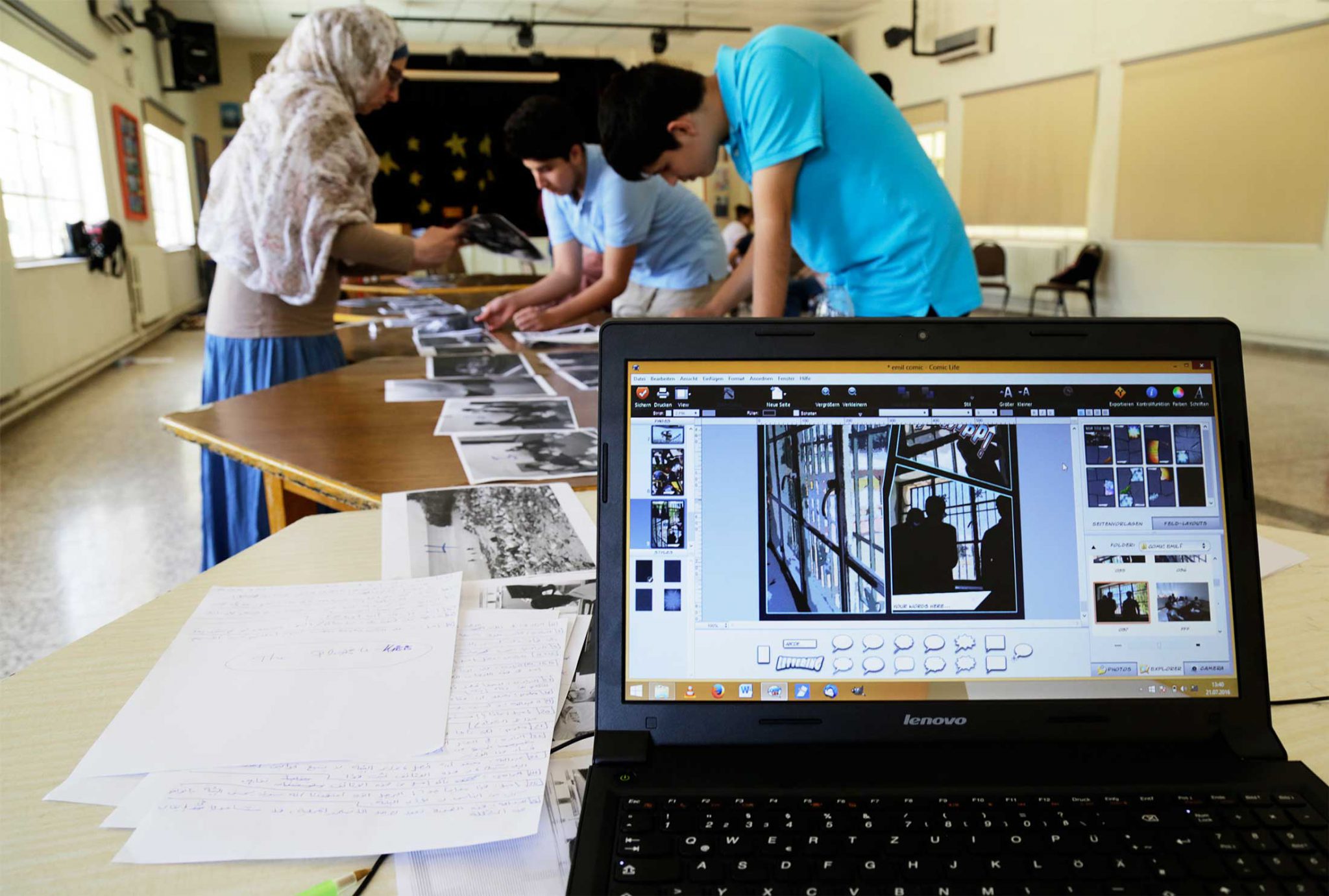
Foto-Wolfgang-Hauck-20160719-Workshop-13w

The idea behind choosing comics as a medium was that they could be used at very different language levels, from individual words such as exclamations and simple main sentence structures in speech bubbles to more complicated content that was written down in entire texts. The young people were given help with more difficult structures such as subordinate clauses, perfect tenses, etc. We mainly checked spelling and grammar with regard to the result, but also explained orthographic and morphological features to the pupils. During this project work, we occasionally had to resort to explanations in English to explain the procedure, in particular how to use the software.

However, the young people picked up on this very quickly and were absolutely adept at using the program by the end. Last but not least, the idea of producing a comic was also suitable because after a week’s work the pupils also had something to hold in their hands. We printed out the results produced during this time and the pupils were thus able to present their classmates and parents with three “real” self-produced comics.

We repeatedly checked during the workshop that the participants were also using German among themselves, which was sometimes difficult as everyone had the same mother tongue and kept falling back on it in the discussions. We usually let this go for the time being, as it increased productivity and thus also the motivation of the participants. Nevertheless, we always made sure that certain fixed structures and vocabulary were used.

All in all, this workshop was a wonderful experience for me. This creative linguistic work with the young people was great fun. I was amazed at how motivated the young people were to use and expand their German language skills as much as possible. Particularly in the “interview” group, German language acquisition was given a high priority with regard to the topic of the future, career, studies after the interview with a German-speaking Jordanian doctor. Some expressed interest in an exchange program in Germany.

CONCLUSION
My experience is that the permeability and flexibility of this workshop and the consideration of both the interests and the language level of the participants led to an enormous boost in their motivation and willingness to get involved in the workshop.

We were also able to teach the students how to use the relevant media (photo, video, comic software) so that they can continue working on their ideas after the workshop. The feedback from the participants was very positive and over the course of the seven days I could already see an improvement in the language level, which I mainly attribute to the confidence the students gained in being able to use their acquired language skills.

LINKS
Goethe-Institut Amman, Jordan

GI_Logo_horizontal_green_sRGB

K-I-D-Z DaF Documentary Theater

./

Landsberg – Berlin – Istanbul – and back

from Andrea Schmelzle

In cultural refugee and youth work, the Landsberg cultural association “dieKunstBauStelle e.V.” teaches cultural mediation techniques on a national and international level in cooperation with the theater “Die Stelzer”.

Landsberg am Lech, 27 June 2016: The Landsberg cultural association “dieKunstBauStelle e.V.” is increasingly bundling its know-how and expertise in the field of cultural youth work as an organizational body and is active at national and international level with the teaching of cultural techniques. The principle of training trainers in order to achieve a multiplier effect is always at the forefront: local trainers are trained as multipliers under professional guidance, who in turn train further trainers and provide children with cultural activities.

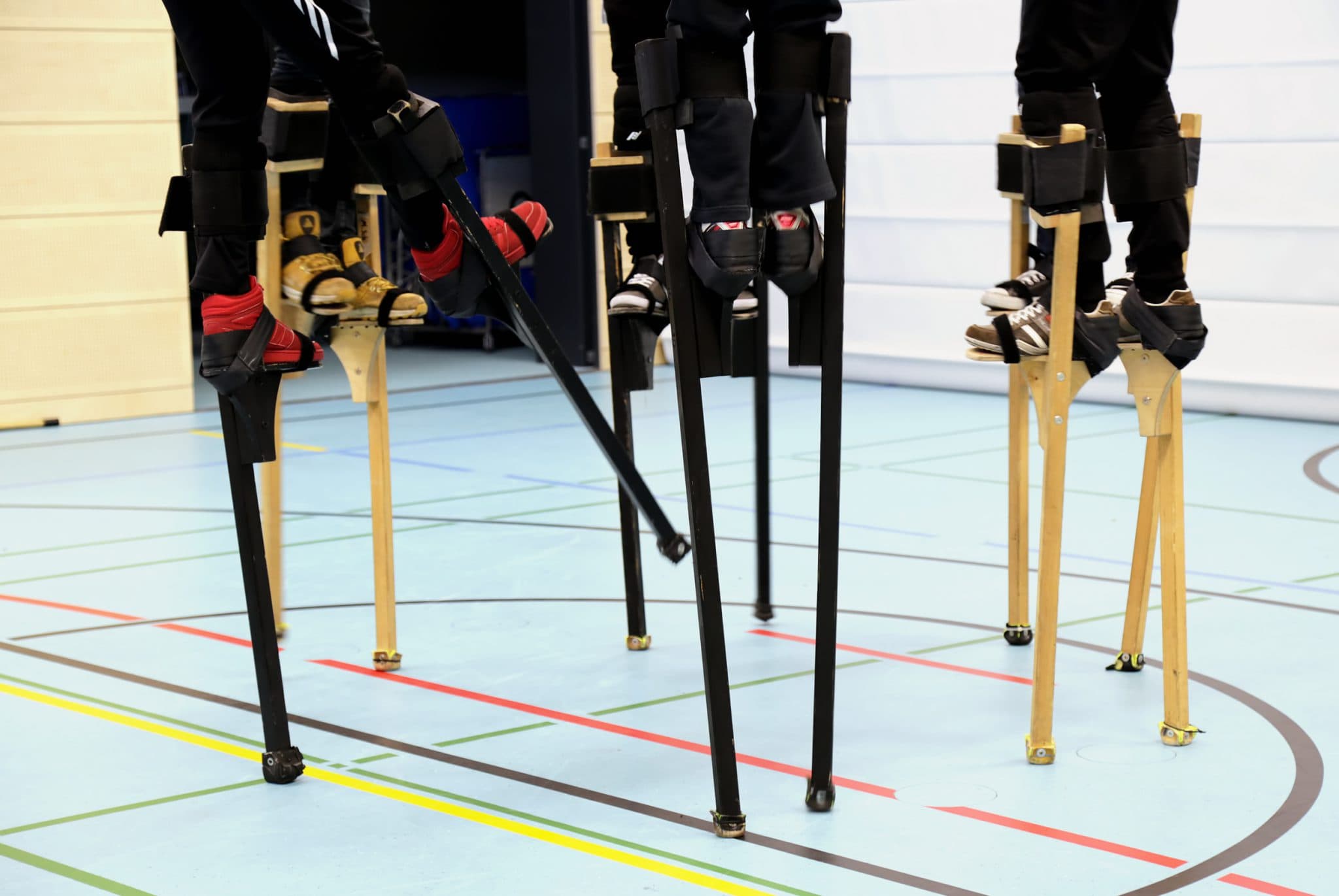
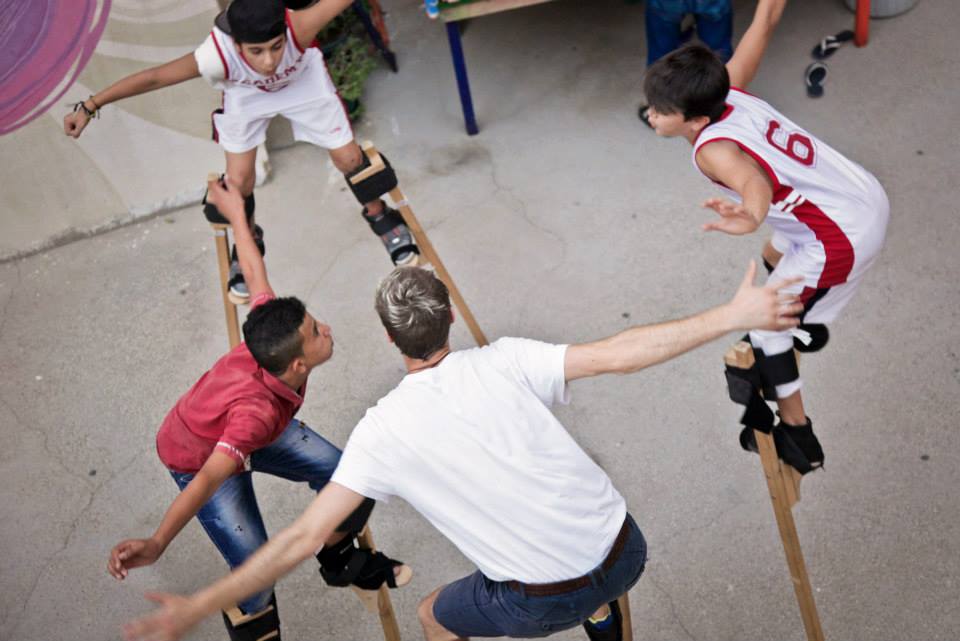
The format was developed by the director of “Die Stelzer” theater, Wolfgang Hauck, and has been implemented in Turkey together with members of the ensemble since 2014. The work with stilts forms the basis, which is combined with other activities such as costume construction, music or circus techniques as “social circus”. Working with stilts in particular has proven to be an excellent means of trauma education.

It all started in Landsberg am Lech with stilt courses. Back in 2008, “Die Stelzer” gained experience working abroad with street children in Morocco. This was followed by courses at schools and, as part of the open-air theater “Licca Line”, the development of a youth group over more than four years. The model of the stilts, which was originally constructed with the Landsberg vocational school for the play “Licca Line”, is now in use all over the world – in Austria, Northern Ireland, Italy, Iraq and Turkey.

20151 Photo Wolfgang Hauck - KIDZ Zinneberg Stelzen 2

Culture as a perspective: international work in Turkey
Since 2014, “Die Stelzer” have been working with refugees in Turkey as part of their “Cultural Relief Program”. In part directly on the Turkish-Syrian border in refugee camps and in the city of Mardin. The activities have now been extended to Istanbul. As around 250,000 refugees live in the Turkish metropolis alone, the model project is being transferred there in order to multiply the effect. This involves working with aid organizations that offer a wide range of refugee support services in Turkey, such as the “Foundation for the Refugee Education Trust – RET” – in Kiziltepe, or the “Red Crescent” in Istanbul. The Goethe-Institut Istanbul is involved as an organizer and sponsor, and the NGO “Her Yerde Sanat Derneği” from Mardin acts as a local partner to the respective refugee camps and the Turkish administration. This cooperation enables “Die Stelzer” to offer and carry out the relevant training courses.

The often traumatized young refugees not only need basic humanitarian care, but also perspectives and rays of hope in their everyday lives full of hardship. “The longer the refugees stay in one place – and this also applies to the situation here – the greater the need for culture and education,” explains Wolfgang Hauck, initiator of the Cultural Relief Program. “Culture, theater, dance and music are becoming immensely important for young people. On the one hand, to improve their life situation, and on the other, to prepare and support their independent participation in life.”

11040943_653733798095242_1629970784630979328_n

“Simple stilts or hammer handles as percussion instruments are enough to make a difference here,” continues Hauck. “It’s an important experience for the children that, despite everything they’ve been through, they can get back to an everyday life where there is something like fun, joy and friends.”

Just a few days ago, he returned from a nine-day stay in Istanbul. He was once again supported by Landsberg residents Leonard Mandl from the Stelzer ensemble and Anselm Kirsch (percussion teacher). The reason for the trip this time was World Refugee Day on June 20, 2016 – and the team was in great demand:

“In Esenler – a district in Istanbul with 500,000 inhabitants – we offered our workshops on the children’s street in collaboration with the Insan Kaynaklari Gelistirme Vakfi foundation
,” reports Hauck. “One day later, we were in Bakirköy – at the Hipodrom. Here, aid organizations and 500 children were invited to take part in various courses in cooperation with Project Lift. The next day, we finally went to Kücükcekmece, another district of Istanbul, for a stilt and circus workshop for educators from the Red Crescent social institution.

The Federal Foreign Office brings “Die Stelzer” to Berlin
Due to the international experience gained from cultural work with young refugees in Turkey, the Stelzer’s work is now also being requested at federal level. “In Berlin, we have presented our Cultural Relief Program twice to members of the Bundestag and experts from various committees,” reports Hauck. For example, at the “Moving People” forum in April this year: the entire spectrum of Germany’s foreign cultural and educational policy was presented over three days.

In August, they will be going to Berlin again for a presentation on the occasion of the Federal Foreign Office’s Open Day. “Workshops lasting several hours will be held in which young people from Iraq will work for us as trainers,” says Hauck. And they are good acquaintances of the Stelzer family, as they are the very young people who were once trained in the refugee camps in Turkey. “They have now fled to Germany, live in Berlin and support us as trainers,” says Hauck happily.

Funding from the Free State of Bavaria
The cultural projects of the dieKunstBauStelle association and the Stelzer are also in demand and recognized throughout Bavaria:
In Glonn, dieKunstBauStelle, together with the Stelzer and in cooperation with the Schloss Zinneberg youth welfare facility, runs an extracurricular educational measure to promote the linguistic and cultural integration of unaccompanied refugee minors together with German schoolchildren. “By combining physical and artistic activities, it is possible to provide special support in listening comprehension and speaking,” emphasizes Hauck. “Education and language acquisition is the first step towards successful integration into society.”

20151 Photo Wolfgang Hauck - KIDZ Zinneberg Percussion Anselm Kirsch 4

This educational project “KIDZ Zinneberg” also convinced the Ministry and is now receiving funding from the 2016 Cultural Fund of the Free State of Bavaria so that it can be continued alongside schools in the 2016-2017 school year.

“Back to the roots”: focus back on Landsberg and the surrounding area
Thanks to the success of projects such as “KIDZ Zinneberg” and film reports by the German Foreign Office, among others, more and more organizations and institutions have contacted Hauck to become active with similar models: In the Landsberg district, for example, a cooperation with “Sternenwünsche”, a project of the Rotary Club Ammersee-Römerstraße for children and young people aged five to 17, is now in preparation. A special cultural program for young people could be held as early as the coming summer vacations. A project week is planned with youth welfare facilities in the Landsberg district and the Ammersee region.

“It is important to us to support associations or projects where we can see that the money is actually felt and is not just ‘sand in the gears’,” says Silvie Braun, one of the “Sternenwünsche” ambassadors, explaining the motivation for supporting the KunstBauStelle. “We really appreciate the association and think it’s great how it brings very different cultures and people together with its projects. Much more needs to be done for children and young people in particular, because after all, children are the future – our future.”

And that applies to people all over the world, whether they come from Syria, Iraq, Turkey, Berlin or Landsberg.

Zinneberg education project receives funding from cultural fund

Ebersberg constituency representative Thomas Huber has announced that the KIDZ Zinneberg educational project will receive funding of EUR 21,600 from the 2016 Culture Fund. The cultural association “dieKunstBauStelle e. V.” is planning to implement an extracurricular educational measure in cooperation with the Schloss Zinneberg youth welfare facility to promote the linguistic and cultural integration of unaccompanied refugee minors together with German schoolchildren. The theater “Die Stelzer”, which already accompanied the pilot phase in 2016, will again accompany the trauma education work.

“Education and language acquisition is the first step towards successful integration into society. By approving this funding, the Free State of Bavaria is once again underlining this and sending out a strong signal,” said Huber.

Over the course of the 2016/2017 school year, 26 creative days are to be held in the form of workshops with up to 70 pupils from the vocational integration classes at the vocational schools in Wasserburg and the vocational school for special educational needs at Schloss Zinneberg, as well as the special needs center for social and emotional development at Schloss Zinneberg. In the workshops at Schloss Zinneberg, teaching content is specifically addressed in consultation with the teachers with the aim of creating valuable synergy effects between project work and regular lessons. The final event is a project week at the end of the school year, which culminates in a performance and/or exhibition.

Thomas Huber sees a lot of potential in the project and demands: “If it turns out at the end of the project that everyone involved benefits from the measure, then an expansion of this model to the whole of Bavaria should be considered,” summarized Huber.

Cultural Fund 2016 comprises 6.1 million euros – including over 600,000 for education

This year, a total of 462,000 euros is available for the education sector from the 2016 Cultural Fund, plus almost 174,000 euros for follow-up measures from last year. Almost 128,000 euros of the funding will now go towards adult education and church education work, while around 334,000 euros are available for other cultural events ranging from music festivals and theater projects to integrative and inclusive education and art projects. Across Bavaria, a total of 20 projects in the field of education will be supported by the 2016 Cultural Fund. “The cultural fund supports culture and education across the board and in all regions of our state,” explains Huber, the CSU parliamentary group’s spokesperson for demographic policy.

Information on the project at: https://diekunstbaustelle.de/portfolio/k-i-d-z-zinneberg-2015-kulturelle-integration/

Thomas Huber: Website Thomas Huber – Zinnebergprojekt

Pictures: © Wolfgang Hauck

Video statements on “The panther in the island pool”

The first video for the art and youth project “The panther in the Inselbad” is online on YouTube:

YouTube video

The participants of the panel discussion “Can the panther be a sin” are introduced here and give statements on the artist Fritz Behn and his panther sculpture.

They comment on Behn’s contradictory and multi-layered personality, who was clearly a right-wing politician and was active during the Nazi era, which raises questions such as “Is Behn’s art Nazi art?” or “Is there even such a thing as Nazi art”?

And of course to his work, the panther, which is at home in the Landsberg Inselbad. Here, too, questions arise: How is the panther perceived? How is it treated? Is its place in a public space appropriate for a work of art?

The video also features sound bites from Landesberg residents who were previously interviewed by the young people.

With:

  • Colonel Daniel Draken, Commodore of Air Wing 61
  • Norbert Köhler, board member and technical director of Stadtwerke Landsberg am Lech
  • Manfred Deiler, President of the European Holocaust Memorial Foundation
  • Dr. Joachim Zeller, historian, author of “Wild Modernity”
  • Wolfgang Hauck, artist and project initiator
  • Karla Schönebeck, journalist and moderator of the panel discussion

Can the panther be a sin? – Podium discussion April 9, 2016

Can the panther be a sin?
1937 Penzing Air Base – 2016 Inselbad Landsberg
Panel discussion on dealing with 20th century art
An event as part of the project “The Panther in the Inselbad”.

Lecture and panel discussion
Saturday, April 9, 2016 at 7:00 pm
Meeting room of the Landsberg am Lech district administration office

Participants in the panel discussion

Colonel Daniel Draken – Commodore of the Air Transport Wing 61
Norbert Köhler – Member of the Board of Stadtwerke Landsberg am Lech
Manfred Deiler – President of the European Holocaust Memorial Foundation
Dr. Joachim Zeller – historian and author of “Wild Modernity”
Wolfgang Hauck – Artist and project developer
Karla Schönebeck, journalist, moderation

Background
Wolfgang Hauck’s art project began in 2014 with information from journalist Karla Schönebeck about a panther sculpture in the municipal Inselbad swimming pool in Landsberg am Lech. Almost everyone in Landsberg should know this black panther in the Inselbad. But how did such a work of art end up in a municipal outdoor pool? How old is it and why is it there?

On this evening, the current and new results will be presented for the first time. The path of the panther was traced geographically, historically and politically, drawing circles that nobody had even begun to suspect. This “Panther” brings together a wide variety of themes with contemporary references that span a broad arc between history, public art and the past.

In addition to artists, journalists and historians, this socio-cultural project also involves young people and refugees who have entered into this debate with an open mind. The first part of the project was dedicated to historical research, the second part will be the artistic realization. Against this background, a public and open exchange is necessary and desirable.

On this evening, in addition to the exciting and surprising facts about the history of the Panther, the discussion will also focus on the topics of colportages, rumors, assumptions and which paths are conceivable for a new culture of remembrance. The question of opportunities for a contemporary culture of remembrance for the town and district of Landsberg am Lech will also be discussed.

DOWNLOAD
Flyer 2016 Panther podium discussion
Poster 2016 Panther podium discussion

FUNDING
Bavarian State Ministry of Education and Culture, Science and the Arts (Kulturfonds Bayern)
Fonds Soziokultur, Bezirk Oberbayern, Rotary Sozialfonds Greifenberg-Schondorf. e.V.

WEBSITE
www.derPanther.org

Exhibition: THE RED THREAD

THE RED THREAD – COLORFUL WORLDS
MARCH 17-23, 2016

COLUMNED HALL LANDSBERG AM LECH

OPENING HOURS
Monday to Friday 13-19 UHR
Saturday and Sunday 11-19 UHR

Vernissage Friday, March 18 at 7 p.m.
Workshops Saturday-Sunday 1-5 p.m.

A PROJECT FROM
dieKunstBauStelle
Die Stelzer – Theater auf Stelzen
Mittelschule Landsberg am Lech

FUNDING
Funded by the project “Jugend ins Zentrum” of the Bundesvereinigung Soziokultureller Zentren e.V. as part of the program “Kultur macht stark. Bündnisse für Bildung” program of the Federal Ministry of Education and Research.

The exhibition is supported by the Cultural Office of the City of Landsberg.

POSTERS
2016 The Red Thread Poster A3 Blue web
2016 The Red Thread Poster A3 Red web

THE PANTHER IN THE INSELBAD – WEBSITE

The project website with pictures and articles is online!

WEBSITE
www.derPanther.org

ARTICLE ON THE PROJECT “THE PANTHER AT THE INSELBAD
Press reports in the Landsberger Tagblatt.
Missed it? Here are the articles to read!

ARTICLES IN THE LANDSBERGER TAGBLATT
24.03.2016 An animal sculptor and politics
19.03.2016 The brother turns up in Cologne
14.03.2016 On the trail of the panther
12.03.2016 The odyssey of the mysterious panther
10.03.2016 Where does the panther actually come from?

On the trail of history’s secrets

Almost everyone in Landsberg will be familiar with the black panther in the Inselbad. The heavy bronze sculpture stands right next to the main swimming pool and also serves as a practical storage place for towels and swimming gear. But how did such a work of art end up in a municipal outdoor pool? How old is it and why is it there? In the near future, young people from Landsberg will be looking into these questions as part of a new project by the “dieKunstBauStelle” association.

Relic of the past
The panther is not the only relic from the past that is a natural part of the townscape. The stone inscription at the “Zum Mohren” inn also caused a lot of headaches for a long time. In the meantime, the cryptogram from 1647 has been deciphered, as you can read in the Landsberg history pages. “These objects often just stand there. They are so commonplace that people don’t normally think about historical contexts,” says Wolfgang Hauck, the initiator of the project.

This is why the new project group first wants to raise awareness of the need to take a closer look at things that seem to be taken for granted. The prerequisite for this is knowledge of local history. The pupils and young people are accompanied in their search for clues by journalist Karla Schönebeck, among others, who is preparing the historical research. In addition, there are excursions to a foundry, archives and interviews with contemporary witnesses: “Only with in-depth knowledge is it possible to establish a context between the past and the present. And,” adds Schönebeck, “with this knowledge, the participants can develop their own attitude to historical events.”

Research and artistic debate
However, it is not just about contemporary history. Hauck’s aim with the project is also to explore artistic aspects. “It’s an experiment with an uncertain outcome, as the young people are also supposed to implement their findings artistically,” says Hauck, explaining his ambitious project, which he describes as a “work in progress”. This form of qualified approach is intended to result in a multimedia exhibition in the form of texts, paintings, photography, installations and performances. The participants will be accompanied by visual artists.

“From what we’ve found out so far,” say Hauck and Schönebeck, “it’s clear that it should be very exciting.” Both are confident that, together with the young people, they will make an important contribution to historical awareness for the town of Landsberg. The fact that young refugees are also involved in this project should also be another interesting component. “It will bring a completely different perspective to the table,” Hauck is convinced.

TV report on the Cultural Relief Program

TURKEY: A circus for refugee children
Film report by Deutsche Welle about the “Cultural Relief Program” and the Circus Heros in Mardin.

“More than a million children have become refugees as a result of the civil war in Syria. Cultural workers and private helpers are now trying to help some of these children – with a German-Turkish children’s circus.”

VIDEO Deutsche Welle 2016

TV report Deutsche Welle

Link to the video is unfortunately no longer available.